How to Check a Baby Name’s Meaning Without Repeating an Unsourced Claim
An appealing meaning can travel far without a reliable reference. Verify the specific spelling and language, and distinguish documented etymology from a modern family association.
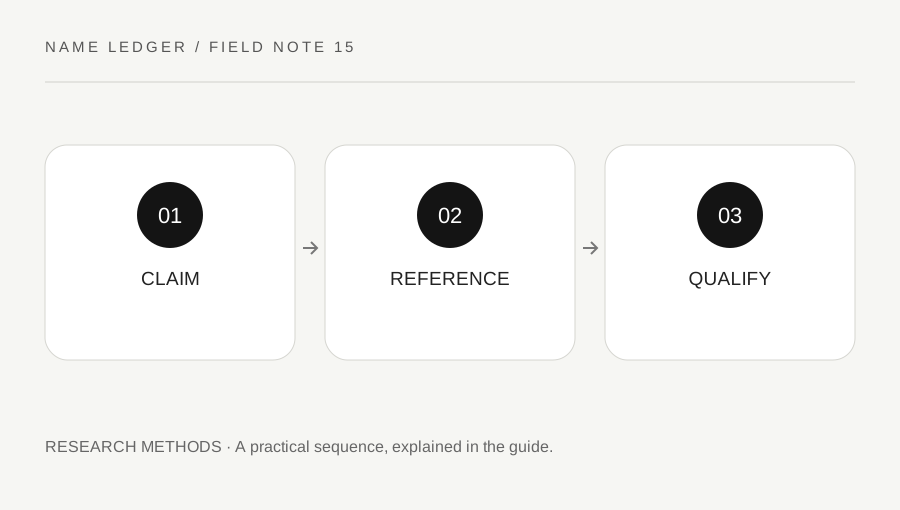
Original explanatory diagram. Numerical examples in this guide illustrate the reasoning; they are not a claim of hands-on testing.
Write down the exact claim
Copy the claim into a private research note with the page title, source and date you consulted it. Identify whether it describes an origin, a literal word meaning, a historical form, a religious association or a modern interpretation. These are different kinds of statements, even when a short list presents all of them under one Meaning heading.
Keep the exact spelling and language visible. A similar-looking form in another language may have a different history, and a modern association does not automatically establish an ancient derivation. Do not treat a popularity count as support for the meaning. The SSA source behind the explorer does not provide etymologies, so no meaning can be recovered from its counts or categories.
Look for a traceable reference
Prefer a reference that identifies its author, scope and evidence and explains uncertainty where it exists. A reputable language-specific dictionary, scholarly naming reference or documented historical source may be more useful than dozens of identical unsourced lists. Follow cited references when accessible and check that they actually discuss the spelling you are considering.
Multiple pages repeating the same sentence do not necessarily provide independent confirmation. They may share an uncited source or copy one another. Ask whether the reference explains how the form developed and whether the translation is direct or interpretive. If you cannot verify the claim, label it uncertain rather than filling the gap with a confident story. A candidate can remain personally meaningful without a fully established linguistic account.
Use an example with no invented etymology
Imagine a family finds a list saying their favorite candidate means strength. The page gives no language or reference. They do not repeat that as a fact. Instead, they look for a name-specific source, compare the exact form and discover that the explanation needs qualification. This is a method example, not a claim about any particular name’s origin.
They keep two separate notes: the verified information they can support and the personal association they enjoy. Perhaps strength remains the quality they connect with a relative who used the name. They can describe that family connection honestly without saying the word is a literal translation. This distinction preserves the meaningful story while avoiding an unsupported linguistic claim.
Respect culture and individual usage
A language or tradition is not represented by every online list using its label. Seek relevant knowledge and avoid asking one person to speak for an entire culture. If someone offers a family usage, treat it as valuable knowledge in that scope rather than automatically generalizing it. Pronunciation and significance can vary between places and communities.
When sharing a candidate, use wording that matches the evidence: a documented origin, an uncertain proposed link or a personal association. Avoid claims that a meaning predicts personality or destiny. The final name choice does not need an impressive historical story to be valid for a family. Reliable research supports a clearer explanation; it should not manufacture certainty simply because a short description looks better beside a name.
Keep a short source trail for later
Save the reference title, author where available, relevant entry and the specific point it supports. A bare screenshot without context can become hard to verify later. If two credible references disagree, retain the disagreement instead of silently choosing the version you prefer. You may decide the uncertainty is acceptable or that the meaning is too central to the choice to leave unresolved. Either way, the shortlist note should make the status clear so a provisional explanation is not repeated as established fact at a later family conversation.
A practical checklist
Tick items for your own use. This checklist is saved only in this browser.
Questions that come up
Can the explorer tell me what a name means?
No. The underlying file contains name strings and counts, not verified etymologies. Meaning needs a different source.
Do many identical websites confirm a claim?
Not necessarily. Repetition may come from one unverified source. Look for traceable independent evidence.
Can a family association still matter?
Yes. Describe it as a personal or family connection rather than presenting it as a literal linguistic meaning.
References & scope
Background references checked on 18 October 2026. The examples and practice exercises are original editorial explanations, not copied procedures or professional advice.