Build a Baby-Name Shortlist That Stays Useful
A shortlist should reduce repeated searching and make the next conversation easier. Keep a few real candidates, a clear reason for each and a record of what you still need to check.
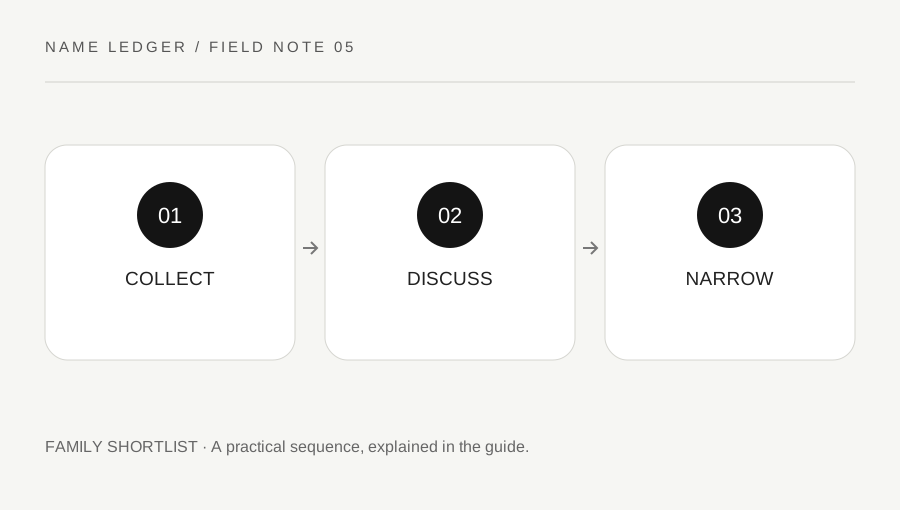
Original explanatory diagram. Numerical examples in this guide illustrate the reasoning; they are not a claim of hands-on testing.
Agree on a few useful criteria
Before searching, discuss what matters to the people making the decision. Possibilities include a family connection, a preferred language form, compatibility with a surname or a wish for a familiar spelling. Keep the criteria small enough to use. A long set of absolute rules can eliminate candidates without revealing whether those rules reflect genuine priorities.
Separate requirements from preferences. A specific honored relative might be a firm commitment, while a matching initial may simply be enjoyable. Write a sentence explaining each firm requirement. This avoids moving the rules whenever a new favorite appears. Popularity can be one preference, but the explorer cannot decide how much weight it deserves or whether a candidate has personal meaning.
Collect candidates without collecting everything
Use filters to find names that fit a written initial, length or recorded-use range. Add only candidates you would genuinely discuss. The local shortlist holds a limited number so it remains a comparison rather than a second database. You can remove a candidate later without making a claim that the name is bad or unsuitable for someone else.
Keep any private notes outside a public shared page. The shortlist itself is stored in this browser when storage is available, not synchronized to an account. Another device will not automatically have it, and clearing site data can remove it. Use the CSV download if you want a portable reference, and store that file somewhere appropriate for the family information it may accompany.
Discuss one dimension at a time
Compare exact spellings first, then intended pronunciation, full-name rhythm and any personal connection. Review counts as a separate source-based observation. Trying to resolve every dimension in one conversation can turn a small difference in recorded use into an argument about an entirely different preference. A note about what remains undecided can help everyone prepare for the next discussion.
Ask for a reason when a candidate is strongly liked or disliked, without demanding that every preference become a logical proof. Some reactions are personal and valid without a data explanation. Decide whose input is actually part of the decision. Public polls can create noise and expose a private family discussion, so use them only if that is something the people involved genuinely want.
Use an illustrative shortlist meeting
Imagine two decision-makers each bring four candidates. They combine the list, keep the exact spelling of each form and notice that two entries are variants of a shared favorite. They do not silently merge them. Instead, they compare the writing and pronunciation of those forms, then look up their separate counts in the same year's source data.
They narrow the list to three candidates and assign one useful follow-up to each: confirm a family spelling, try the full sequence with the surname, and consult a language-specific pronunciation reference. At the next conversation, they review those findings rather than starting an entirely new search. This example is a process suggestion, not a claim that every family should share authority or make the decision in the same way.
Close the list with a checked master copy
When a choice is made, write the intended full name carefully and compare it letter by letter. Confirm any middle names, spacing and punctuation against the relevant registration instructions. The journal does not determine legal acceptability, and a name's presence in the published U.S. data is not a registration approval for another place or situation.
Keep a backup of the shortlist only if it remains useful. The clear-shortlist control removes the saved candidates from this tool's local storage, but it does not delete CSV files you downloaded or copies you shared. Manage those separately. A useful final record is a clear choice and any verified details needed to use it, rather than an ever-growing collection of rankings and speculative meanings.
A practical checklist
Tick items for your own use. This checklist is saved only in this browser.
Questions that come up
Will my shortlist appear on another phone?
No. It is local to this browser when storage is available. Download a CSV if you need a portable reference and manage that file yourself.
Does clearing the shortlist delete my exported CSV?
No. The tool cannot remove files you already downloaded or shared. Delete or retain those separately.
Should a vote choose the winner?
A vote can show preferences among the people invited, but it does not establish the best choice. Decide deliberately whose input belongs in the process.
References & scope
Background references checked on 18 October 2026. The examples and practice exercises are original editorial explanations, not copied procedures or professional advice.