A Name Appears in Both SSA Categories: Compare the Rows Carefully
The same spelling can appear in more than one source category. Read those rows as published observations, and keep recorded categories separate from rules about who can use a name.
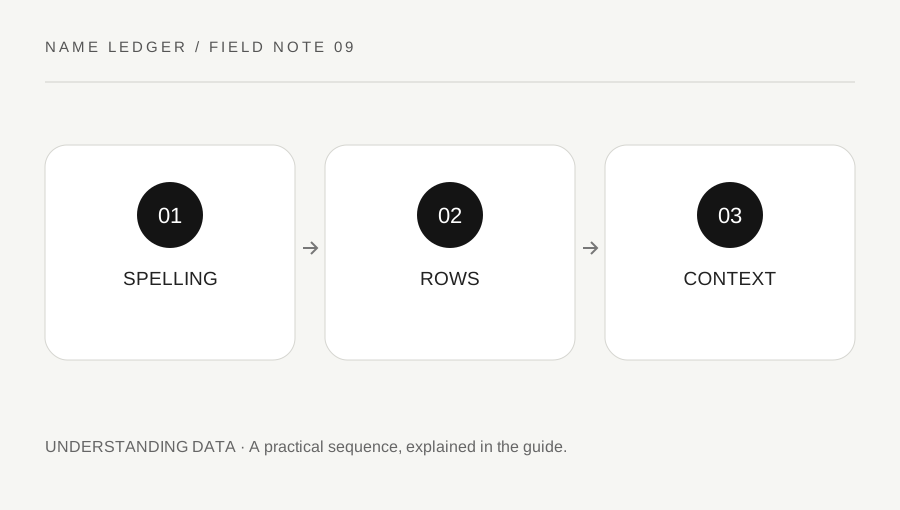
Original explanatory diagram. Numerical examples in this guide illustrate the reasoning; they are not a claim of hands-on testing.
Start with an exact-spelling search
Use Exact spelling with all source categories selected. This avoids confusing a similar-looking name with another row for the same string. Read the year, category, count and displayed position together. A result in one category and an absent result in another does not prove exclusive use, because the published file has limits and only covers its defined records.
The explorer preserves the source’s F and M labels so the counts can be interpreted faithfully. It does not assign a permitted identity to a candidate or predict the identity of someone who uses it. Personal and community naming practices are broader than one administrative dataset. Keep that boundary visible when sharing a screenshot or making a shortlist note.
Compare counts without inventing a category rule
If both rows appear, record their counts separately. The displayed positions belong to different sex-specific lists, so comparing position alone can be misleading. A position of a particular number in one list does not necessarily correspond to the same count in the other. The count gives a clearer direct comparison within the same published year.
You can add the two published counts for a clearly labelled personal total, but that remains your calculation for the available rows. It is not a global total or a complete measure of identity, pronunciation or cultural use. Do not present a ratio from these rows as a prediction of how another person will interpret a name in a particular community.
Use a hypothetical two-row example
Imagine a spelling with hypothetical counts of 800 in one source category and 200 in the other. The arithmetic ratio of the published counts is four to one. That describes the example rows; it does not tell you the probability of a stranger making a particular assumption about a person, and it does not capture missing records or uses outside the source scope.
The family can still discuss how the candidate feels in their own setting. They might ask willing relatives for their personal associations, while avoiding the claim that a handful of opinions represents a country or language. Keep source data and personal impressions in separate notes. Each can be useful without pretending to answer the other’s question.
Choose language that matches the evidence
A careful statement is that the exact spelling appears in both published categories for the displayed year. A broader label such as universally neutral or exclusively associated with one group requires different evidence and may still depend on place and time. Avoid turning a convenient website category into an absolute description of a name.
If historical change matters, consult the official multi-year source and compare consistent definitions. This explorer contains one year, so it cannot establish that use is becoming more balanced or moving toward one category. For a family choice, return to the intended spelling, pronunciation, surname and personal significance. The data can inform the conversation while leaving identity and preference outside a ranking rule.
Preserve both rows in a portable comparison
The shortlist can save the same spelling under each published source category as separate entries. The CSV includes the category and year so they remain distinguishable outside the page. Do not remove those columns when sharing a count comparison, because the numbers would lose their context. If you make your own combined figure, label the calculation and retain the original rows nearby. This simple provenance habit helps a family discussion stay accurate without requiring the tool to impose a social label on the candidate.
A practical checklist
Tick items for your own use. This checklist is saved only in this browser.
Questions that come up
Does appearing in one category limit who can use a name?
No. The tool preserves source categories to explain counts, not to set a rule about identity or permitted use.
Can two rows be compared by position alone?
Read counts too. The positions come from separate lists and can represent different frequencies.
Does the explorer show a shift over time?
No. It contains a single published year. A trend question needs consistent historical data.
References & scope
Background references checked on 18 October 2026. The examples and practice exercises are original editorial explanations, not copied procedures or professional advice.