Comparing Baby-Name Spellings: Count Each Form Deliberately
Similar-looking or similar-sounding names do not automatically form one category. Keep exact spellings visible, then discuss pronunciation and family preference as separate questions.
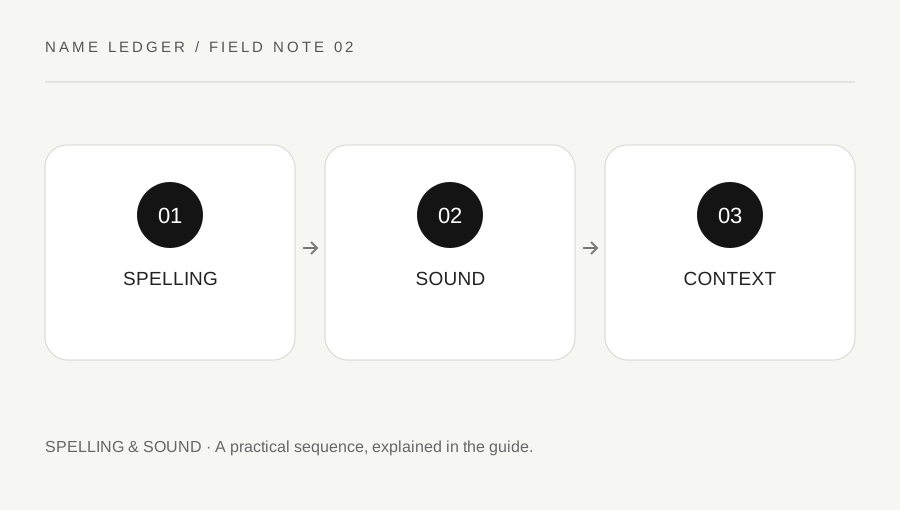
Original explanatory diagram. Numerical examples in this guide illustrate the reasoning; they are not a claim of hands-on testing.
Write the exact forms you are considering
Start a short list of the spellings your family would actually consider using. Include capitalization in your personal notes if it matters to presentation, while recognizing that the explorer performs case-insensitive text searching. Avoid adding every variation you can imagine simply to produce a larger combined number. A comparison is more useful when each candidate represents a genuine choice.
Read every result row carefully. A one-letter difference can identify another recorded spelling, and a spelling that looks related may be pronounced differently by different families. The published data is a record of name strings, not a pronunciation dictionary. The explorer does not infer that two rows have the same sound or declare one form an authentic version and another a mistake.
Understand what the source groups and separates
The SSA describes qualifications for how it tabulates the first-name field, including its treatment of spacing and hyphens. Similar spellings are not automatically combined merely because a reader considers them variants. Read the source background if punctuation or a compound name matters to your comparison. The displayed data should not be treated as a complete description of how a name was written on every original document.
For practical shortlisting, keep exact source rows separate and attach your own note explaining why you are comparing them. This makes the boundary clear. A count for one spelling is not the count for every sound-alike, and adding selected variants together creates your own analytical grouping rather than a newly official name ranking.
Test the day-to-day writing experience
Try writing each genuine candidate with the expected surname and any middle name. Read it aloud, then ask a trusted person to write it after hearing it once, if they are comfortable helping. Treat the result as one small observation from that person and context. It does not establish how all teachers, colleagues or communities will respond.
Notice which corrections you would be happy to make routinely and which would bother you. Some families value a particular heritage spelling even when others are less familiar with it. Others prefer a form that is common in the languages they use most. Neither preference is settled by the data. The goal is to understand the practical tradeoff and choose it deliberately.
Use an illustrative two-spelling exercise
Imagine a family considering two invented example forms, Liora and Leora. They write both with the surname, discuss their intended pronunciation and ask relatives which form connects to their family history. These are candidates for an exercise; the example does not assert their origins, meanings or equivalence in every language. Any cultural claim would need a reliable name-specific reference.
They then look up each exact spelling in the same year and source category, recording the separate counts if present. If they choose to add those counts in a private note, they label the result as their own two-form grouping. They do not call it the official popularity of a pronunciation, because other forms and language differences may exist. This keeps a useful family comparison from becoming an unsupported claim.
Keep records and decisions clearly separated
Save the candidates as separate shortlist entries and note which is your preferred spelling. Before any official registration, use the relevant authority's current instructions for permitted characters and required fields. This journal offers practical exploration rather than jurisdiction-specific legal advice, and a spelling appearing in the U.S. data does not establish that every registration system will accept it.
Once the family decides, make a carefully checked written master for any forms you are authorized to complete. Compare letters rather than relying only on how the name sounds. Retain discussion notes only where useful and do not publish private family details with a public shortlist. The final choice should express the family's intended name, with popularity used as context and exact spelling treated as a real part of that choice.
A practical checklist
Tick items for your own use. This checklist is saved only in this browser.
Questions that come up
Can I add similar spellings together?
You can make a clearly labelled personal grouping, but it is not an official rank and does not necessarily capture every spelling or pronunciation you have in mind.
Does a spelling tell me one correct pronunciation?
Not always. Languages, communities and families can use different pronunciations. Ask the people and sources relevant to your intended use.
Should unusual spelling rule a name out?
That is a family preference. Consider the personal connection and the likely correction routine instead of treating frequency as a universal rule.
References & scope
Background references checked on 18 October 2026. The examples and practice exercises are original editorial explanations, not copied procedures or professional advice.