How to Discuss Name Pronunciation Across a Family
A pronunciation conversation works best when people describe what they intend and listen to actual examples. A spelling, automated voice or popularity count cannot settle every language difference.
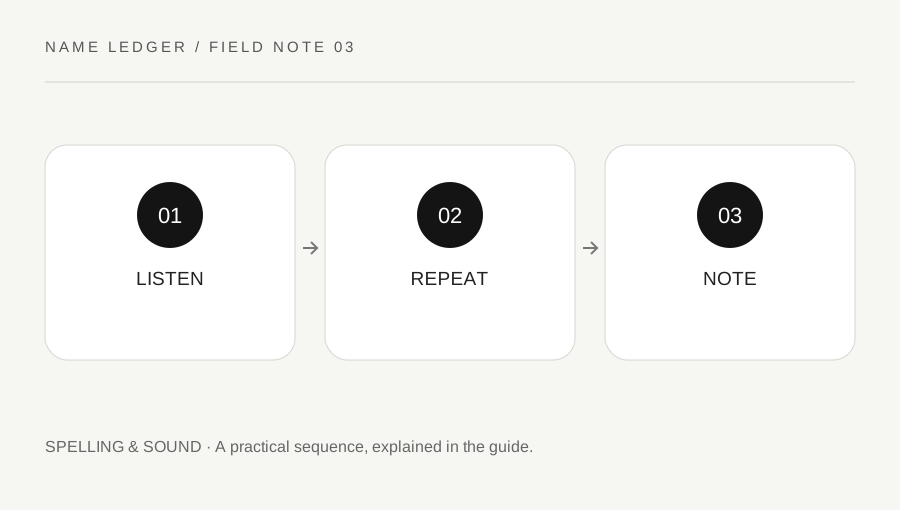
Original explanatory diagram. Numerical examples in this guide illustrate the reasoning; they are not a claim of hands-on testing.
Begin with the pronunciation you intend
Say the candidate naturally in a sentence rather than only as a carefully isolated sound. Include the surname if that is relevant to the discussion. Ask the other person what they heard and whether they want to repeat it back. The purpose is to understand each other, not to test someone or rank an accent as correct or incorrect.
If you are choosing a name associated with a language you do not speak, seek a reliable language-specific reference or someone with relevant knowledge who is willing to help. Do not infer an origin or a universal pronunciation from an online list that offers no evidence. This journal does not provide authoritative phonetic entries, and the name explorer's data contains no recording of how each family says the name.
Expect variation without making it a problem
The same spelling may be read differently in different places. That does not make every difference a failure or make the spelling unsuitable. Discuss which pronunciation the family intends, which variations feel acceptable and which correction you would comfortably make. Keep the discussion grounded in the languages and communities that are actually part of your life.
Avoid asking one speaker to represent an entire country, ethnicity or language. A person's reading is one useful observation, not a universal result. If several pronunciations matter to the family, collect them carefully and acknowledge the variation. A respectful conversation can reveal that a candidate works well in more than one form, or that a particular difference would be inconvenient for your situation.
Try realistic phrases and introductions
Use a small set of ordinary phrases, such as a greeting, a school-style introduction and the full name spoken at normal speed. Notice transitions between the end of the given name and the beginning of the surname. Sounds that seem separate when read slowly can blend in speech. Write down the observation without assuming that everyone will experience the same effect.
Ask helpers only for the detail you need. You do not need to circulate a recording publicly or attach private family information to a pronunciation question. If you record your own voice for comparison, keep it on a device and in a location you control. A simple written note about preferred stress or a familiar comparison may be enough for the family's discussion.
Work through a multilingual shortlist example
Imagine a family using English and another language at home. They have three candidates. For each one, they say the full name in both languages, ask two willing relatives about their natural readings and note where stress differs. This is an illustrative process, not evidence about any particular name or language pair.
One candidate has two forms the family likes, another repeatedly needs a correction they are comfortable explaining, and the third sounds too similar to a sibling's name in normal conversation. These observations help them narrow the list without pretending to calculate a pronunciation score. They can still consult the name explorer for recorded U.S. use, but that separate number does not confirm or refute what they learned from listening.
Choose what deserves a reliable reference
If the pronunciation is tied to cultural, religious or family significance, verify the relevant claim through an appropriate reference or knowledgeable person. Keep the distinction between a family tradition and a broad historical assertion. “Our family uses this form” is a narrower statement than “this is the only correct form,” and it may be all the explanation you need.
End with a short pronunciation note you could use when introducing the name, if helpful. Keep it clear and kind rather than defensive. Do not promise that a chosen name will never be misread; everyday language does not work that way. The useful outcome is a shared understanding of the intended form and a correction routine the family can live with, alongside room for respectful variation.
A practical checklist
Tick items for your own use. This checklist is saved only in this browser.
Questions that come up
Can the explorer pronounce the names?
No. It is a text-and-count explorer, not a pronunciation database. Verify a preferred pronunciation through reliable name-specific language resources.
Is one relative enough to establish a language rule?
One person can describe their own knowledge and usage. Broader claims need appropriate references and attention to regional and community variation.
Should every pronunciation difference be corrected?
That depends on the family preference and context. Discuss which variations matter rather than assuming that all variation has the same significance.
References & scope
Background references checked on 18 October 2026. The examples and practice exercises are original editorial explanations, not copied procedures or professional advice.