Evaluate an Online Baby-Name List Before Trusting Its Labels
A useful list explains where its information comes from and what its labels mean. Check the source behind claims such as rare, traditional, international or fast-rising before using them as facts.
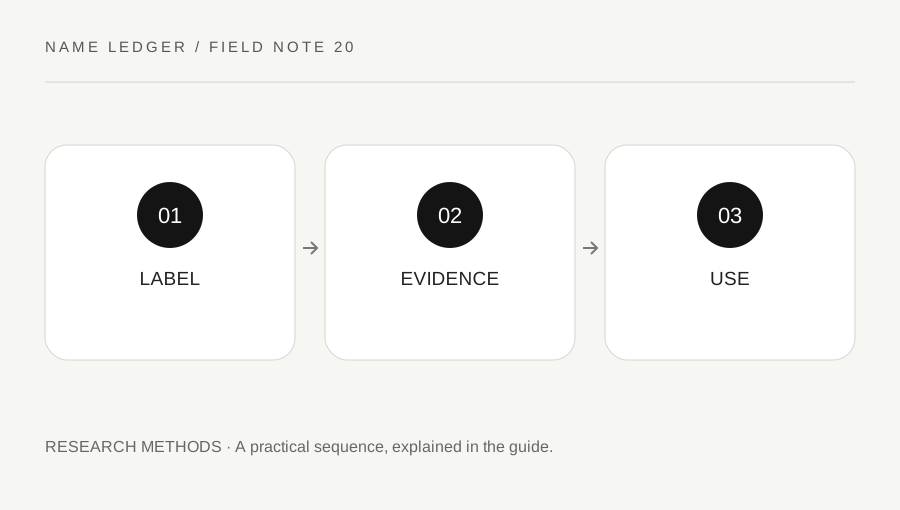
Original explanatory diagram. Numerical examples in this guide illustrate the reasoning; they are not a claim of hands-on testing.
Identify which claims need evidence
Separate the author’s taste from factual statements. A list of names the author likes can be helpful as inspiration without representing a measured population. A claim that a name is the fastest-rising, has a particular origin or appears only in one country needs appropriate evidence. Attractive design and a confident tone do not supply that evidence on their own.
Read the date, author information and any methods or source links. Ask whether the page gives the year and geography for popularity claims and a traceable reference for meaning or pronunciation. Do not assume that one source supports every label in the article. A government count file may support recorded use while offering nothing about the name’s etymology or personality associations.
Check the operational meaning of a label
Rare might mean below a chosen rank, absent from a top list or simply unfamiliar to the writer. International might mean present in two datasets or may be an unsupported impression. Traditional could refer to one family, a documented historical usage or an undefined style. Ask how the label was assigned before treating it as a fact about the candidate.
If the writer provides a definition, decide whether it matches your question. A name uncommon in one year’s national data can still be familiar in your community. A list grouped by first letter may be useful for discovery without measuring overall popularity. You can keep the inspiration while declining an unsupported interpretation; the page does not have to be entirely accepted or entirely dismissed.
Work through a list-check example
Imagine a page calls ten candidates unique and says one means courage, but supplies only a link to a top-one-hundred popularity list. That link cannot establish worldwide uniqueness, and it does not verify the meaning. A careful reader saves any appealing candidate, then checks its exact spelling in a suitable source and seeks a separate language-specific reference for the meaning.
The reader might conclude that the list is useful for ideas but not sufficient evidence for those labels. This example is a method, not an accusation about a particular website. The important habit is to match each claim to the source that could actually support it. Repetition across many similarly worded pages is not necessarily independent verification.
Keep a source note without turning the search into a project
For a genuine finalist, record the reliable information that matters to the decision and leave unsupported fields blank. You do not need a full research dossier for every name you glance at. Focus effort where a factual claim would materially influence the choice, such as a cultural connection the family intends to honor.
Return to the family criteria after checking the claim. A candidate can remain appealing even when an online label turns out to be vague. Do not replace one absolute rule with another, such as rejecting every popular name or every name absent from a source. The useful outcome is a shortlist built from genuine preferences and carefully bounded evidence, with speculation clearly separated from what you can verify.
Watch for a mismatch between headline and tool
A page may advertise trends while its tool displays a single year, or offer meanings while its source contains only strings and counts. Check what the interactive result actually measures. If a chart lacks a time axis, denominator or source, avoid inventing the missing context yourself. This journal’s explorer is deliberately a one-year exact-spelling tool. Keeping that narrow description visible makes it easier to use the data well and to seek another source when the question moves beyond its scope.
A practical checklist
Tick items for your own use. This checklist is saved only in this browser.
Questions that come up
Does a source link validate every statement on a list?
No. Check whether the linked source directly supports the particular claim, such as count, origin or trend.
Can a subjective list still be useful?
Yes, as inspiration, provided its preferences are not mistaken for measured facts or universal rules.
Must every candidate have a verified meaning?
No. Decide whether that information matters to the family choice. Leave an uncertain claim unverified rather than inventing an answer.
References & scope
Background references checked on 18 October 2026. The examples and practice exercises are original editorial explanations, not copied procedures or professional advice.