Compare U.S. and England-and-Wales Name Lists Without Mixing Their Scope
Lists from different places can broaden a shortlist, but their counts are not interchangeable. Keep geography, year and methods attached to every comparison.
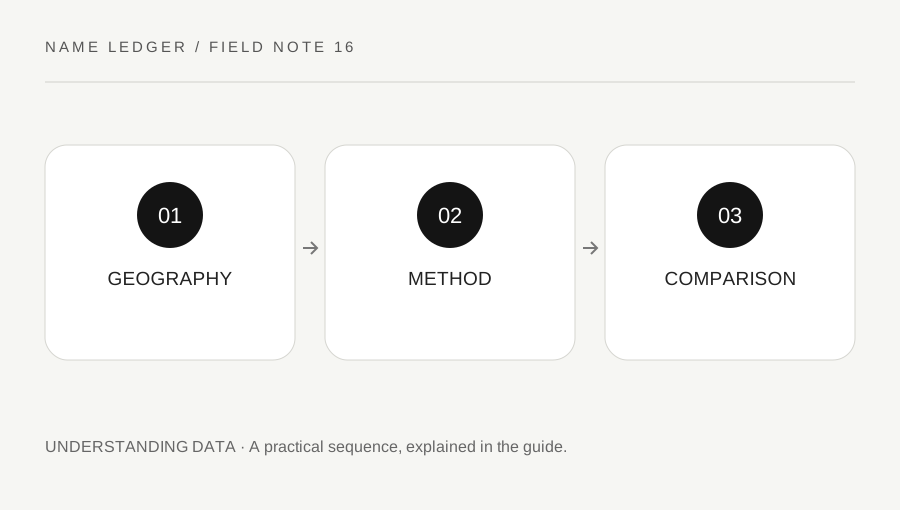
Original explanatory diagram. Numerical examples in this guide illustrate the reasoning; they are not a claim of hands-on testing.
Name the geography precisely
The explorer uses national U.S. data from SSA. ONS publishes baby-name statistics for England and Wales using birth-registration information. England and Wales is not a synonym for the whole United Kingdom, and U.S. national data is not a measure of every English-speaking family. Use the source’s own geography in any caption or note.
Choose the same birth year where available, or clearly label a mismatch. Publication dates can differ from the year the names describe. A release appearing this year may summarize an earlier birth year. Before comparing positions, make sure you are not accidentally placing one country’s current release beside another country’s different period merely because the page headings both say latest.
Read methods before comparing small differences
Check each source’s definitions, spelling treatment, categories and publication limits. A name string may be handled differently between datasets, and a small missing count may reflect a publication rule rather than no use. Do not assume the same numeric position has the same frequency or share in two populations of different sizes.
Keep exact rows separate until you have a defensible reason to group them. Similar spellings and pronunciation families require decisions that the original lists may not make. If you create a personal grouping, label it and retain the original values. A combined transatlantic ranking is not produced merely by adding two counts, because the scope and analytical question need to be defined first.
Use a two-place comparison exercise
Imagine a candidate has a hypothetical position of 40 in one source and 90 in the other. That tells you its order among the respective published rows under each method, not that it is used a fixed multiple as often in the first place. Read counts and any relevant published shares before making a frequency comparison. These positions are invented for illustration rather than actual results.
A family may simply want to know whether the exact spelling appears in both sources. That narrower question can be answered without constructing a new global index. They record each year, geography and source, then return to pronunciation and surname fit. Data from two places can add context without needing to identify which country has the better version of the name.
Use local relevance without assuming uniform culture
If the family expects to use the name in more than one place, seek practical perspectives relevant to those settings. A national list does not establish a single national pronunciation or guarantee familiarity in every community. Ask willing people about their own usage and consult name-specific language references where needed. Keep those observations distinct from the administrative counts.
For official registration or documents, use the relevant authority’s current rules. A name appearing in another country’s list is not proof of acceptance by every system. The useful outcome is a shortlist with clearly labelled evidence from each place, plus a family understanding of what the comparison can and cannot show. Avoid broad labels such as universally international when the evidence covers only two datasets.
Make a simple source comparison card
For each source, record geography, birth year, release date, exact spelling, category, count or rank and the relevant methodology link. Leave a field unavailable when you cannot verify it rather than substituting a number from another site. This small card is enough for many family discussions and makes later checking much easier. It also reveals when you need a different source, such as Scotland or Northern Ireland, instead of treating England-and-Wales results as a complete answer to a wider geographical question.
A practical checklist
Tick items for your own use. This checklist is saved only in this browser.
Questions that come up
Does ONS England-and-Wales data cover the entire UK?
No. Use the appropriate sources for the geography you actually want to examine.
Can equal positions mean equal frequency?
Not necessarily. Populations, counts, distributions and methods can differ. Read the source measures and scope.
Does a name in both lists work in every language?
No. Presence in two administrative datasets does not establish universal pronunciation, meaning or familiarity.
References & scope
Background references checked on 18 October 2026. The examples and practice exercises are original editorial explanations, not copied procedures or professional advice.