Short or Long Baby Names: Compare Written Length and Everyday Use
A short spelling is not always a short spoken name. Compare the written form, preferred pronunciation and everyday context instead of treating character count as a complete description.
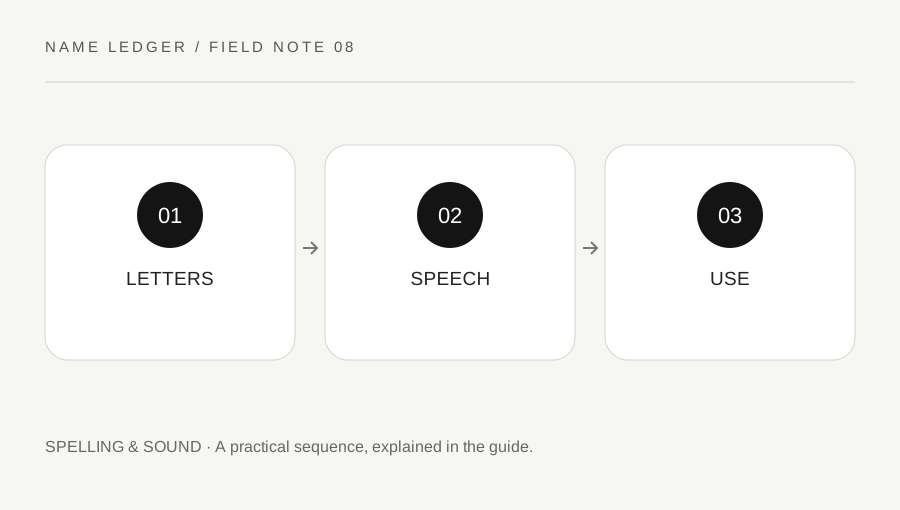
Original explanatory diagram. Numerical examples in this guide illustrate the reasoning; they are not a claim of hands-on testing.
Decide which kind of length matters
Written length affects labels, forms and visual appearance. Spoken length depends on pronunciation and language. These properties can differ, so write down the question you actually want to answer. A preference for a compact written name does not automatically mean a preference for one syllable, and a long family name does not force a short given name.
The explorer’s length filter counts characters in the published spelling. It does not supply syllable counts or promise how a name will be abbreviated. If you use a compound surname or more than one middle name, include those in a full written comparison. A given-name-only count cannot show the total space needed for the complete sequence.
Use a broad range before a strict cutoff
Try a reasonable range of written lengths and inspect real candidates before choosing an exact maximum. A one-character cutoff may remove a favorite without improving daily use. Save names you genuinely like, then compare them with the surname and intended pronunciation. Keep the source year and exact spelling visible when you look at recorded use.
Avoid describing a longer name as automatically difficult or a shorter one as automatically simple. Familiarity depends on the people and languages involved. A short form can need repeated spelling clarification, while a longer form may be familiar in the community. The data does not contain a difficulty score, and the tool deliberately avoids creating one from letter count.
Work through a full-name comparison
Imagine a family comparing a four-character candidate and an eight-character candidate with the same surname. They write both in an ordinary introduction and on a small label, then say each at normal speed. The longer form may have a rhythm they prefer, while the shorter one may look clearer in a particular format. These observations are personal tradeoffs rather than a formula that establishes a winner.
They also discuss whether they would welcome a nickname. A longer official form does not guarantee that others will use the nickname the family expects. A short official form may still acquire an informal version. Write these expectations as preferences, not predictions, and keep the formal spelling clear for any later registration checks.
Check real constraints through the proper source
If a particular form or registration system has a character rule, read its current official instructions. Do not infer legal acceptability from an explorer filter or from the presence of a spelling in U.S. data. This journal does not provide jurisdiction-specific registration advice. Distinguish a genuine administrative constraint from a personal concern about how a label might look.
For ordinary family shortlisting, stop when the length comparison has answered a useful question. You do not need to optimize every possible future form. Keep a small set of candidates and note why each remains appealing. A thoughtful choice can be short or long, provided the family understands the written and spoken forms it intends to use.
Notice what abbreviation changes
Write any likely abbreviated forms beside the full candidate and compare them separately. An initial-only format can conceal a meaningful spelling difference, while an informal short form can become a different name in practice. Ask whether you like both the formal and everyday possibilities without assuming you can control every future usage. If a family connection depends on the full form, record that reason clearly. This gives the length discussion a concrete purpose beyond counting letters and prevents a convenient abbreviation from silently replacing the actual choice.
A practical checklist
Tick items for your own use. This checklist is saved only in this browser.
Questions that come up
Does the filter count syllables?
No. It filters written character length in the published spelling. Syllable counts depend on the pronunciation being used.
Are shorter names always easier to spell?
Not necessarily. Familiarity, language and similar forms affect the experience. Try genuine candidates in your own context.
Should a long surname force a short first name?
There is no universal rule. Compare the actual full sequences and decide what rhythm and writing style you prefer.
References & scope
Background references checked on 18 October 2026. The examples and practice exercises are original editorial explanations, not copied procedures or professional advice.