Honoring a Relative Through a Name: Make the Connection Explicit
An honor name can carry a full spelling, an initial, a sound or a personal association. Clarify which connection matters before choosing a form or comparing popularity.
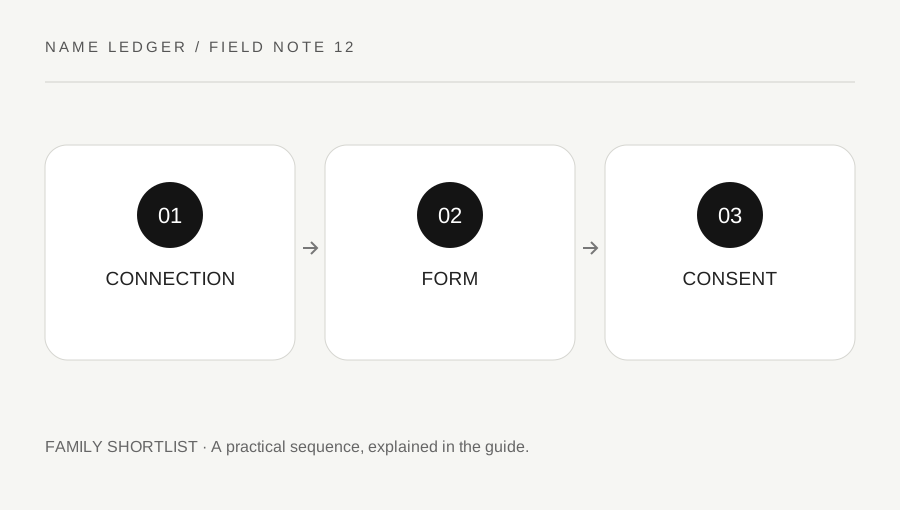
Original explanatory diagram. Numerical examples in this guide illustrate the reasoning; they are not a claim of hands-on testing.
Describe the person and the connection privately
Write a sentence about what the family wants to honor, keeping private details in a suitable place. The connection might be a particular relative, a shared story or a tradition the family values. Different decision-makers may understand the same proposal differently, so explain the intended link before narrowing the spelling.
Do not assume every relative wants to be named or discussed publicly. Where appropriate, ask about preferences and the form they use. An honor connection can also be meaningful without inviting a large group to judge the final choice. Decide whose input belongs in the decision and avoid turning a sensitive family history into content for a public poll or an online naming discussion.
Choose how directly to carry the form
Consider whether the full name, an initial, a middle-name position or another clearly explained association preserves what matters. These options are not universally equivalent; their significance depends on the family and tradition. If a cultural or religious naming convention is involved, consult a reliable relevant reference or knowledgeable person rather than assuming a generic article describes it accurately.
Keep the exact spelling and intended pronunciation visible. A similar-looking form may not have the same history or language connection. You can choose a personal association while labeling it as such. There is no need to invent an etymology to make a genuine family link sound more official.
Use a respectful comparison exercise
Imagine two decision-makers want to honor one relative but prefer different everyday forms. They write the relative’s actual name privately, list the forms they genuinely like and explain which aspect each hopes to preserve. One values the exact spelling; the other values the initial and the story. This reveals the real preference without pretending popularity can settle it.
They then say the candidates with the surname and discuss whether the honor form belongs in the first or middle position. If they consult the explorer, they treat the current recorded-use counts as separate context. A low count does not strengthen the honor, and a high count does not weaken it. The connection is a family reason rather than a statistic.
Check the written master and the story you will share
Once a form is chosen, proofread the full sequence and use the appropriate registration authority’s current instructions. If the family wants to tell the honor story, decide which details are suitable to share and which should remain private. A brief explanation can be meaningful without exposing someone’s health, relationships or other personal history.
Keep room for the named person’s own future relationship with the story. An honor name can express affection without imposing a personality or life expectation. Avoid claims that a name will make someone like the relative or carry particular traits. The useful outcome is a clearly understood connection, a form the decision-makers genuinely want to use and a careful written record for practical purposes.
Handle conflicting preferences without inventing a rule
If relatives disagree about whether a variation counts as honoring someone, record that as a family disagreement rather than searching for a universal ranking of honor forms. A tradition-specific question may have a relevant knowledgeable source, while a personal preference may simply remain personal. Discuss what compromise would feel meaningful to the actual decision-makers. This keeps the process respectful and prevents a website’s popularity data or an unsourced naming rule from being used as authority over a private relationship.
A practical checklist
Tick items for your own use. This checklist is saved only in this browser.
Questions that come up
Does an honor name have to use the exact full spelling?
That depends on the family and any relevant tradition. Clarify the intended connection rather than assuming one universal rule.
Can a similar name be described as the same origin?
Only with appropriate evidence. A personal association can be meaningful without an invented linguistic claim.
Will a name pass on a relative’s personality?
A name does not establish a person’s character. Avoid treating an honor story as a prediction or obligation.
References & scope
Background references checked on 18 October 2026. The examples and practice exercises are original editorial explanations, not copied procedures or professional advice.