What U.S. Baby-Name Data Can and Cannot Tell You
A source becomes more useful when its boundaries are clear. Read national baby-name data as a specific historical record, with publication rules and categories, rather than a global census of names.
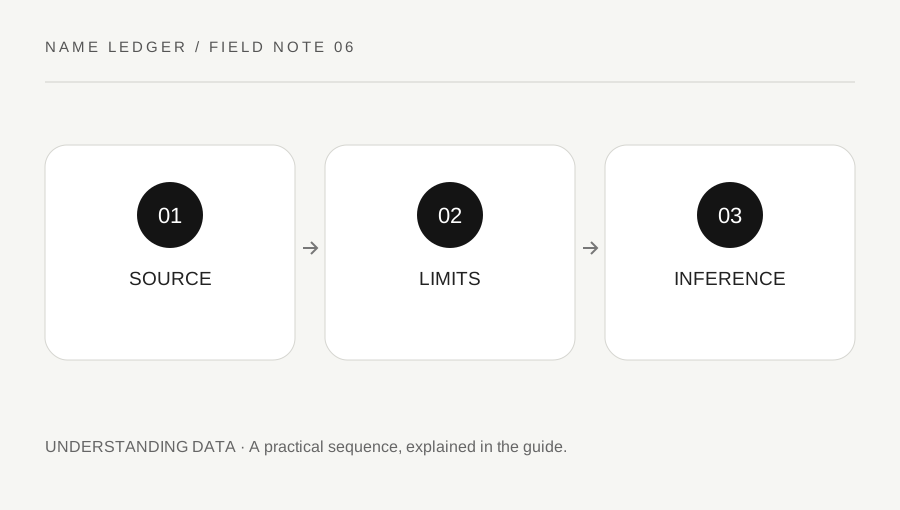
Original explanatory diagram. Numerical examples in this guide illustrate the reasoning; they are not a claim of hands-on testing.
Keep the year and geography attached
The explorer uses the national U.S. 2025 file published by the Social Security Administration. Its record type and geographic scope come from that source. It is not a list of everyone living in the United States, every English-speaking child or every family worldwide. Keep the year and country in a caption whenever you copy a count into a note or share a comparison.
A national total can also hide variation between places. A name that is uncommon nationally may feel familiar in a particular community, and a high national count does not guarantee a duplicate in a specific classroom. If regional use matters, consult an appropriate regional source and read its own qualifications. Do not treat the national figure as a local prediction simply because it is the easiest number to find.
Understand absence and source categories
The source suppresses very small counts for privacy, so the published file is not a complete list of every used spelling. If a search returns nothing, first check the spelling and filters. Then read the source limits before claiming that the name was never used. The explorer displays published rows; it does not invent an estimated count for a missing entry.
The source includes sex categories attached to the records. This tool preserves them for interpreting the published counts rather than assigning a permitted identity or use to a name. A spelling can appear in more than one category. Compare each row deliberately and avoid treating a missing row or a filtered view as a rule about who can use a name.
Do not infer meaning or individual characteristics
Counts describe recorded uses of a name string in a specific source. They do not establish a name's etymology, religious significance, pronunciation, ethnic identity or the character of a person who has it. Those are different questions requiring relevant sources and, in some cases, direct knowledge of the individual. The explorer intentionally does not generate meanings or personality descriptions from a spelling.
If a cultural or historical connection matters to your choice, verify it through a reliable reference for that name and language. Distinguish a documented origin from a modern family association or a popular internet explanation. You can value a personal connection without turning it into a broad factual claim. A large number next to a name does not validate an unsourced story about where it comes from.
Work through an inference check
Suppose a search finds a candidate with a hypothetical count of 240 in the displayed year. A supported statement is that this row has that published count in the specified source category. “Only 240 people in the world have this name” is not supported, because the data does not cover all places, ages or spellings. The example count is illustrative rather than a quotation from the file.
Now suppose the name is absent. “No matching published row was found under these filters” is an accurate description of the result. “Nobody used this name” goes beyond the evidence. Practising these narrower statements helps keep a family discussion grounded, especially when an appealing label such as rare, international or unique would otherwise hide what you actually measured.
Choose a better source when the question changes
Use historical files or the official year tools for a question about change over time. Use the relevant national or regional authority for another geography. Consult appropriate linguistic references for origins and pronunciation, and the proper registration authority for current naming rules. One convenient explorer should not become a substitute for every kind of evidence.
Keep enough provenance in your own notes to reproduce a useful result: year, source, exact spelling, category and any filter applied. The tool's sequential position follows count order with alphabetical ties and should be read alongside the count. A careful boundary does not make the dataset less interesting. It makes the observations more reliable and leaves personal preference free to play its proper part in the final decision.
A practical checklist
Tick items for your own use. This checklist is saved only in this browser.
Questions that come up
Is this a list of all English names?
No. It is a published U.S. national birth-year dataset with source qualifications and privacy limits. It does not classify the language or origin of every name.
Can I predict how popular a name will become?
This one-year explorer does not forecast future use. A forecast would require additional evidence and uncertainty, and still would not determine a family preference.
Why not show meanings automatically?
The source contains name strings and counts, not verified etymologies. This journal avoids inventing those missing facts.
References & scope
Background references checked on 18 October 2026. The examples and practice exercises are original editorial explanations, not copied procedures or professional advice.